Veteran Homelessness and Housing First
April 12, 2026
If you look at the number of homeless people in the US over the past couple decades, you’ll notice a sharp increase in the past several years. The latest official count put the total homeless population at over 770,000, an 18% increase from the previous year and the highest number ever recorded. But there is one group of Americans where this trend hasn’t held: homeless veterans. The number of homeless veterans has decreased by 55% since 2009. Although there are still around 32,000 homeless veterans across the country, the drop in homelessness among veterans stands out as a success, given the otherwise increasing rate of homelessness in general. And while there are fewer veterans now in general, the decrease in veteran homelessness is greater than the decline in the number of veterans.
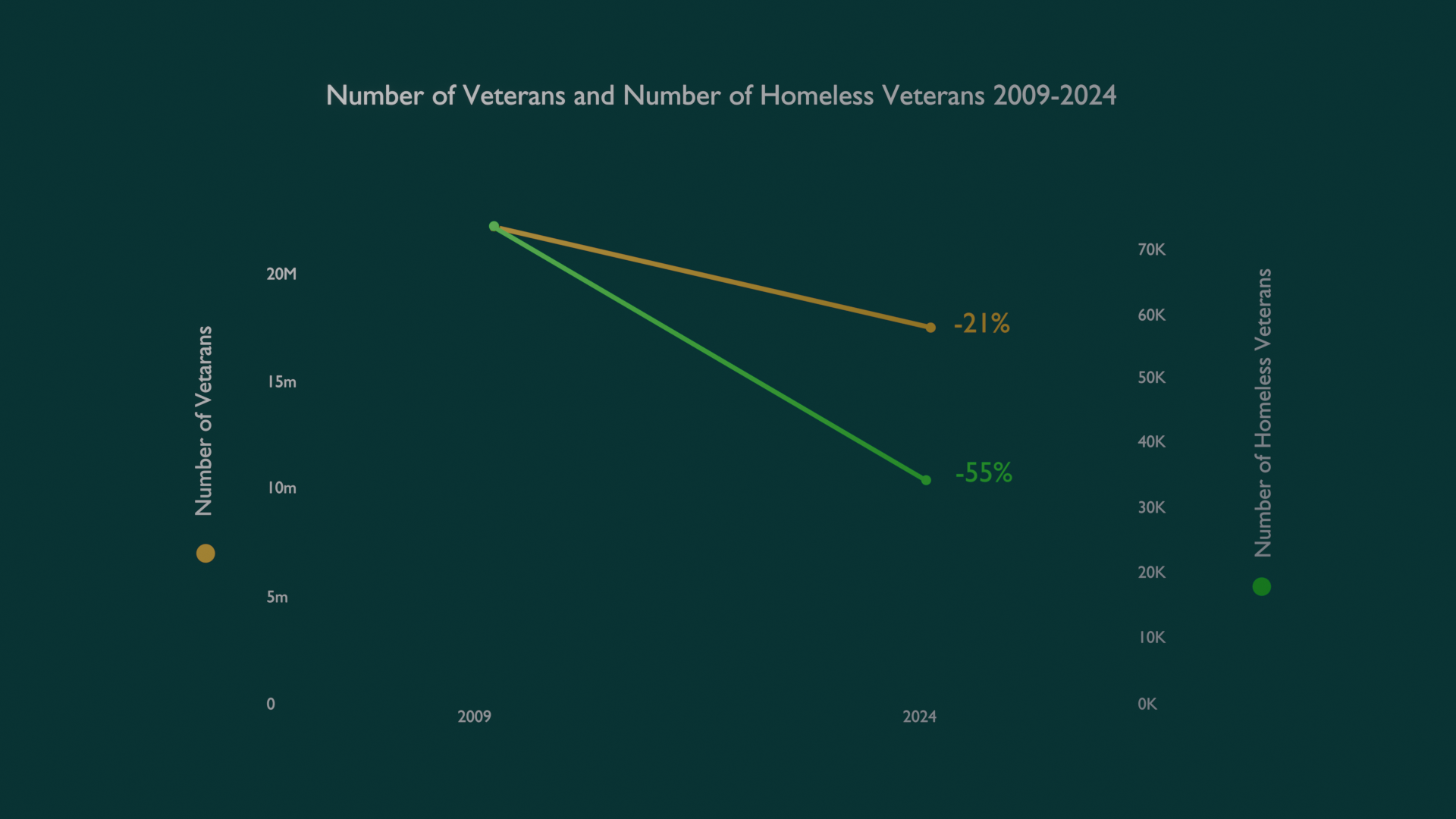
Between 2009 and 2024, the decrease in the number of homeless veterans is twice that of the decrease in the number of veterans.
So, what happened? Declining veteran homelessness is an achievement of HUD-VASH, a partnership between the US Department of Housing and Urban Development (HUD) and Veteran Affairs Supportive Housing (VASH). This partnership began in 1992 as a way to focus on homeless veterans with mental health issues, and the program expanded significantly in 2008 when congress appropriated funds to address the issue of veteran homelessness. In 2008, there were over 70,000 homeless veterans, about 11% of the total homeless population. By the most recent count, veterans make up about 4% of the homeless population. This change is a combination of the general homeless population increasing, while the veteran homeless population decreases. This is especially notable because homelessness is more common among veterans than nonveterans.1
HUD-VASH helps veterans experiencing both sheltered homelessness, such as living in a shared space designated as a homeless shelter, and unsheltered homelessness, such as living in tents, cars, or anywhere not intended for habitation, as defined by the Mckinney Vento Act. HUD-VASH prioritizes veterans who are chronically homeless, defined by the HUD as someone who has been homeless for “at least 12 months or on at least 4 separate occasions in the last 3 years, as long as the combined occasions equal at least 12 months and each break in homelessness separating the occasions included at least 7 consecutive nights of not living as described.”2 Case management and support is important for those experiencing chronic homelessness because they often experience significantly higher barriers to housing than others.
HUD-VASH works with local public health authorities for administering vouchers and local VAs for administrative, clinical, and case management work. The case management that HUD-VASH facilitates is a part of its success, and is mandated for each veteran enrollee, along with treatment plans, which are developed to keep enrollees housed and to address their healthcare needs. Enrollees have the option to receive healthcare through a VAMC, or find a healthcare provider on the market, to be covered by health insurance the VA provides. This treatment support is built on the foundation that stable housing imparts, which is why housing first is the official policy of the VA. HUD-VASH does not require sobriety or have behavioral health requirements prior to housing veterans, as long as they are eligible.
A helpful tool for understanding housing first is Maslow’s Hierarchy of Needs. Psych 101 classes often cover Maslow’s Hierarchy of Needs as a framework for articulating the progression of human needs, usually portrayed as a triangle with basic survival needs at the bottom platform and “self actualization” goals at the top.3 To echo this framework, housing is the foundation that allows veterans and case managers to move up the triangle to tackle more physiological, psychological, and spiritual needs on behalf of the enrollee.
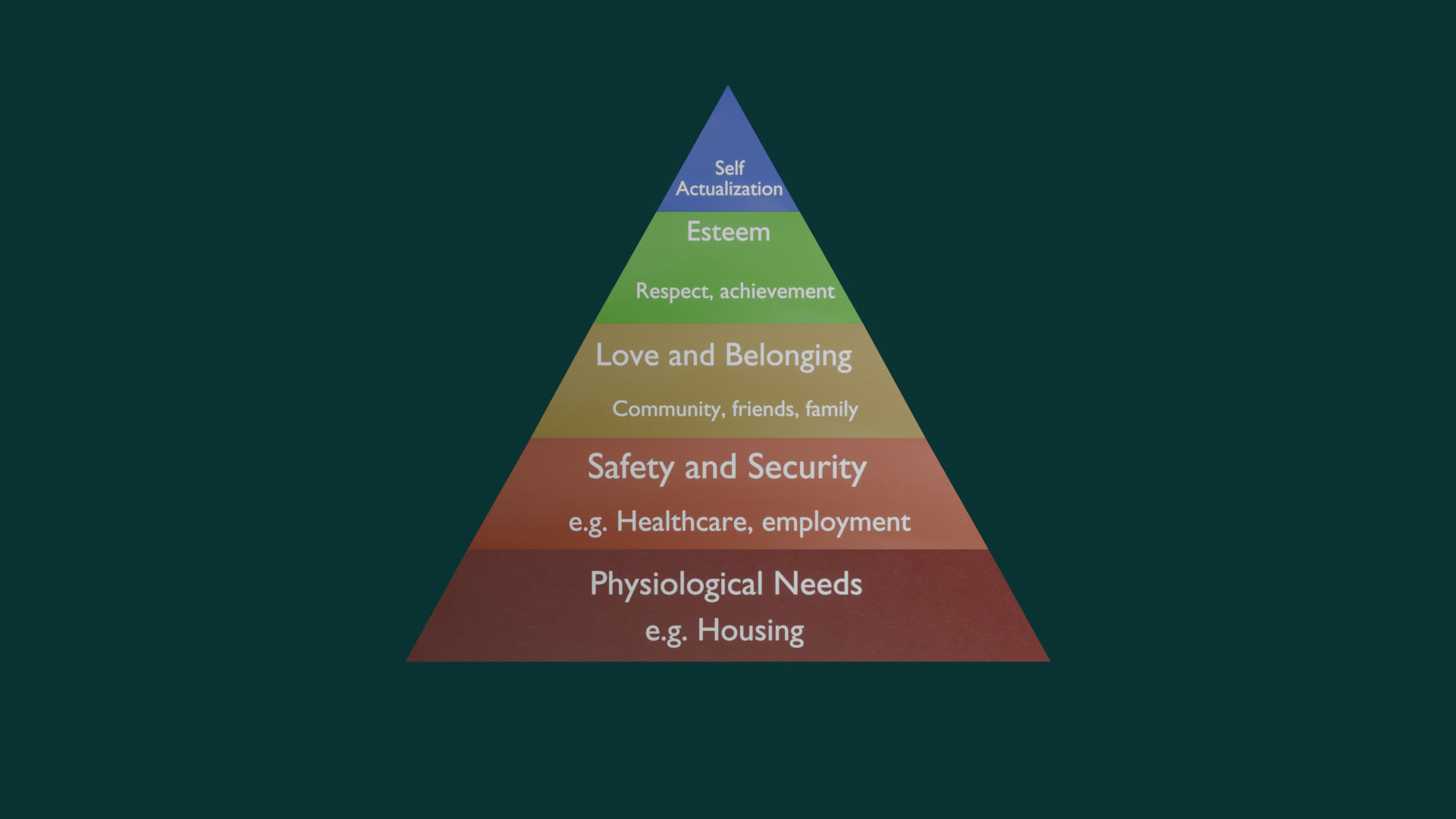
Maslow's hierarchy of needs
Let’s walk through the program with an example. A veteran, Richard, is experiencing homelessness. Richard lives in Grand Rapids, Michigan, and hears about assistance programs through the VA. Staff there help Richard with an initial assessment and gathering paperwork for eligibility. It’s determined that Richard meets the eligibility criteria:
Richard is a veteran, having served in the Navy, and has a general discharge.
Richard is homeless.
Richard’s income, effectively 0, is below the income requirement of 80% of AMI.
. Richard agrees to case management in the program.
Richard is not a registered sex offender.
The application process complete, and Richard waits. With winter approaching, Richard spends some time in a local shelter, where he sleeps on beds in a shared space with others. Fortunately, the VA processes his application and approves it quickly. A unit is finally ready for Richard to move to. Richard is elated to see the message in his inbox that tells him his new address, and quickly packs his several bags of belongings.
The unit Richard moves into is funded by HUD’s housing choice voucher, or section 8 funding system. This means Richard only needs to pay 30% of his income as rent, with the rest covered by HUD. With no income, Richard will not pay anything at first, but once he gets a job, he will pay 30% of his salary.
It’s a month later, and Richard is meeting with his case manager, Bailey. Though initially skeptical of case management, Richard is now grateful for the support. Together they discuss Richard’s progress toward his goals, starting with income - completing 20 job applications in the past week. Richard’s other goals include making a doctor’s appointment for foot pain and narrowing down a list of potential psychiatrists to assess him for PTSD. Together, they also establish a more distant goal that session: finding a pet dog for Richard to adopt. Richard leaves the encounter with a feeling of hope for his future.
Now at this point you might be thinking “okay, this sounds very nice; but if this is so successful, why are there still so many homeless veterans and even more homeless nonveterans?” There are two major limitations I will cover here in response. One is resources. HUD-VASH has allocated over 115,000 housing vouchers in the program’s lifespan, lifting at least that number of veteran households out of homelessness. But there is still a clear gap. An analysis from 2025 showed that HUD and VA fund housing supply for only an estimated 48% of sheltered chronically homeless veterans.4 This also doesn’t take into account the over 13,000 unsheltered homeless veterans. While this housing supply rate is much higher than that of all sheltered homeless adults (about 13%) an increase in resources for these programs would be needed to meet demand. Permanent supportive housing is estimated to cost an average of about $20,115 per person annually. The authors of this analysis give a conservative estimate for what it would take to house the 11,210 sheltered veterans in need of supportive housing: $225,495,362. Unfortunately, funding for HUD-VASH has actually trended downwards from $78 million in 2024 to only $34 million in 2025, halving the amount of vouchers and only widening the gap between supply and demand.
The second major limitation is the housing market itself, varying by region. Grand Rapids, where Richard acquired housing, actually has a fairly low homeless population. There are 1,200 homeless people, or 2 per every 1,000 people in Kent county, which includes Grand Rapids. Nationally, that rate is 2.3 homeless per 1,000 people. And some counties only slightly larger than Kent, such as Multnomah, which includes Portland, Oregon, have almost 14 homeless per 1,000 people, six times the national average. Furthermore, veteran homelessness in Kent County is functionally zero, meaning veteran homelessness in Grand Rapids is considered a solved problem. When a veteran does become homeless, such as Richard, they are quickly housed. As of 2024, there are 3 states and 85 cities or counties that have achieved “functional zero” veteran homelessness.
Homelessness is an effect of the local housing market. In areas with a high cost of housing, like Portland, homeless rates are higher, while in places with lower housing costs, like Grand Rapids, there is less homelessness. Gregg Colburn and Clayton Aldern in Homelessness is a Housing Problem found a positive correlation between median contract rent and PIT homeless count, with R2=0.55 for cities according to 2019 data.5 Even in a relatively successful and affordable housing market, like Grand Rapids, resources for supportive housing help keep people housed, who may be otherwise cut out from market rate housing by behavioral health struggles. At the same time, if housing gets significantly more expensive overall, such as in areas like Portland, then housing support infrastructure will struggle to keep up, and resources would need to be scaled to do so. A large part of reducing homelessness needs to be making housing more affordable in general, through increased supply and density in cities like Portland where housing is scarce relative to the population’s needs.
HUD-VASH is a good example of housing first in action. While it is constrained by regional differences in homelessness, affordability, and overall housing shortages, it has successfully helped its target population and even eliminated homelessness for veterans in many places.
References
Anderson JK, Mackey KM, Beech EH, Young S, Parr NJ. Factors Associated with Homelessness Among US Veterans: A Systematic Review. Washington (DC): Department of Veterans Affairs (US); 2023 Jul. PMID: 37494507.
DEPARTMENT OF HOUSING AND URBAN DEVELOPMENT 24 CFR Parts 91 and 578 [Docket No. FR–5809–F–01] RIN 2506–AC37 Homeless Emergency Assistance and Rapid Transition to Housing: Defining ‘‘Chronically Homeless.’’
McLeod, Saul. (2025). Maslow’s Hierarchy of Needs. 10.5281/zenodo.15240897.
-
Dennis Culhane, Matthew Fowle, and Joy Moses (2025). How Much Would It Cost to Provide Housing First to All Households Staying in Homeless Shelters?**